

Last updated: November 2026
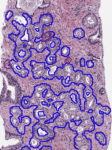 No, AI is not on track to replace pathologists. Today’s pathology AI flags areas for review, counts and measures features, and predicts biomarkers from the slide, but the pathologist still makes the diagnosis and is responsible for it. What AI is changing is the work itself: it takes on repetitive tasks like counting mitoses or measuring tumors, adds a second look on routine cases and helps labs keep up as demand for pathology grows. Below, we look at what AI does well today, where it still falls short and how the pathologist’s role is evolving.
In this article
- What AI does in pathology today
- What the evidence shows
- Where AI still falls short
- How the pathologist’s role is changing
- What pathologists can do now
- How Lumea approaches AI
- Frequently asked questions
What AI Does in Pathology Today
Pathology AI works on digital whole slide images, so it depends on a lab going digital first. Today’s tools generally do one of five jobs:
- Detection: highlighting areas suspicious for cancer so a pathologist can review them, acting as a second set of eyes.
- Grading and quantification: assigning patterns such as Gleason grades, counting mitoses and measuring tumor size or margins.
- Prediction: estimating a patient’s prognosis or likely biomarker status from a routine H&E slide.
- Quality control: catching out-of-focus regions, air bubbles and other scan problems before a pathologist opens the case.
- Triage: sorting the worklist so likely high-risk cases are read first.
Only a small number of these tools are authorized by the FDA for clinical use. Through April 2026, Innolitics counted seven FDA-authorized AI algorithms that analyze whole slide images. Every one of these tools supports the pathologist. None of them signs out a case.
What the Evidence Shows
The strongest results come from pathologists and AI working together, not from AI working alone.
- In the study behind Paige Prostate’s authorization, pathologists using the software improved their cancer detection by 7.3% on average.
- A 2020 study in JAMA Network Open found that when pathologists graded prostate biopsies with AI assistance, their agreement with genitourinary subspecialists rose by 5.6%.
In both cases, AI made pathologists more accurate and more consistent. The pathologist stayed in charge of the result.
Where AI Still Falls Short
Pathologists know where AI still struggles, and those limits are a big part of why the diagnosis stays with them.
- Judgment calls in three dimensions. Reading a flat image of three-dimensional tissue, recognizing structures cut at an angle and telling true tumor invasion apart from its many mimics all depend on judgment and experience.
- Variation between labs. AI trained on one lab’s slides can perform differently on another lab’s stains, scanners and tissue processing. Building models that handle that variation as reliably as a pathologist is still a challenge.
- Narrow scope. Most tools do one task for one tissue type. A pathologist covers the whole case, including findings no tool was built to look for.
- Clinical context. A diagnosis draws on the patient’s history, prior specimens and conversations with the treating physician. AI sees the slide it was given.
- Accountability. Regulators authorize these tools as aids to the pathologist, and the pathologist remains responsible for the diagnosis.
How the Pathologist’s Role Is Changing
AI won’t replace the pathologist, but it is changing what a pathologist’s day looks like.
- Less counting, more thinking. As AI takes on repetitive measurement and screening, pathologists spend more of their time on the difficult cases that need their expertise.
- A new layer of oversight. Someone has to validate AI tools on a lab’s own cases, monitor how they perform and decide when to rely on them. That work belongs to pathologists.
- Generative AI is arriving. Newer tools go beyond single tasks. Modella AI’s PathChat DX, a generative AI assistant for pathologists, received FDA Breakthrough Device designation in 2025, and the HistoGPT research model can draft a dermatopathology report from whole slide images. Breakthrough designation speeds up FDA review but is not a clearance, and report drafting is still in research.
A 2025 review in Diagnostics, “The Rise of AI-Assisted Diagnosis: Will Pathologists Be Partners or Bystanders?”, argued that the outcome depends largely on pathologists themselves: those who adopt digital tools and lead AI oversight are likely to remain essential to the diagnostic process.
What Pathologists Can Do Now
- Get comfortable with digital. AI only runs on digital slides, so a digital workflow is the starting point.
- Learn how AI tools are validated. Knowing how to test a tool on your own cases is becoming a core skill.
- Help choose the tools. Pathologists who are involved in selecting AI end up with tools that fit how they actually work.
- Start with one task. Most labs add AI one use case at a time, beginning where pathologists spend the most repetitive time.
For a step-by-step plan, see How to Implement Digital Pathology.
How Lumea Approaches AI
Lumea is built around the pathologist. AI tools from partners run inside Lumea’s Viewer+, so results appear next to the slide during sign-out, and the pathologist decides when to use them. Labs choose the tools that fit their specialties instead of being locked into one vendor’s algorithms. See the leading options in our list of the top 10 AI companies for digital pathology, or browse the Partner Marketplace.
Frequently Asked Questions
Will AI replace pathologists?
No. Current AI tools support specific tasks such as detection, grading and quality control, and the FDA authorizes them as aids to the pathologist. The pathologist still makes the diagnosis and is responsible for it.
Is pathology still a good career with AI coming?
Yes. AI is changing how pathologists work, not whether they’re needed. Pathologists who are comfortable with digital workflows and AI oversight will be well placed as these tools become routine.
Can AI make a pathology diagnosis on its own?
Not in clinical practice today. FDA-authorized pathology AI tools are designed to assist pathologists, who review the AI’s output and make the final call.
Which pathology tasks is AI best at?
Repetitive, well-defined tasks: finding small areas of cancer on prostate biopsies, counting mitoses, measuring tumors, scoring biomarkers and checking scan quality. Complex judgment calls still depend on the pathologist.
Is AI in pathology FDA approved?
A small number of tools are. Paige Prostate was the first, authorized in 2021, followed by tools such as Ibex Prostate Detect and ArteraAI Prostate in 2025. Many other pathology AI tools are available for research use only in the U.S.
See AI in Your Workflow
Want to see how AI fits into a pathologist-centered workflow? Request a demo of Lumea’s Viewer+.